Agentic Enterprise Architecture Framework
AI agents, governed by your enterprise architecture.
Charterion makes the enterprise model the source of an agent’s authority, and the place it asks before it acts.
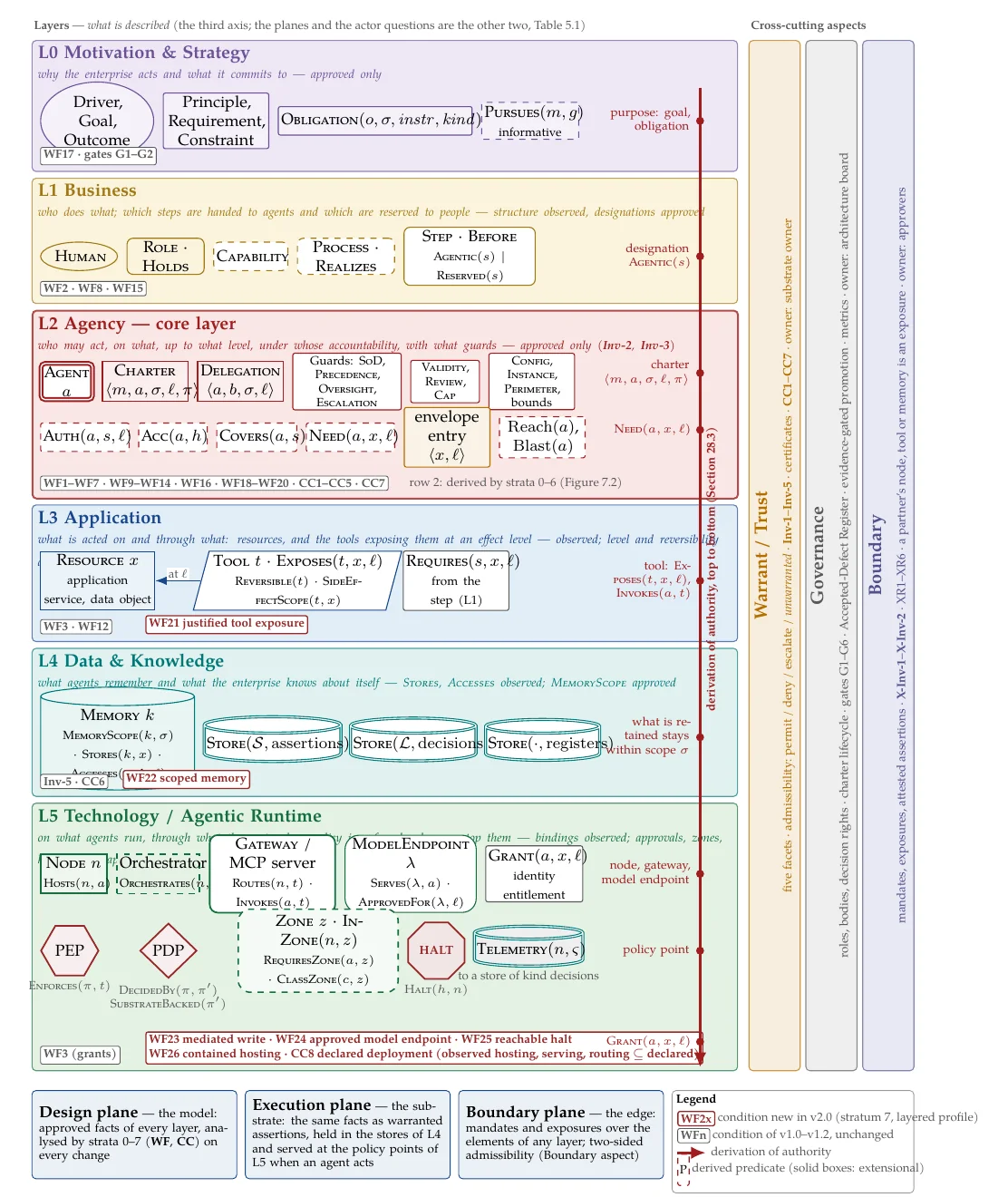
- 6 Layers
- Five keep the element types of ArchiMate 3.2 and TOGAF 10. The sixth, agency, is new.
- Specification, p. 42
- 6 Axioms
- Each one is a condition a program checks on the enterprise model.
- Specification, p. 34
- 4 Answers
- Permit, deny, escalate to a named human, or unwarranted when the evidence is too weak.
- Specification, p. 69
What breaks when the reader is a program
TOGAF, ArchiMate and their peers assume that a person reads the architecture, that only people hold authority, and that change arrives at project pace. Each held when those frameworks were written.
-
What the model leaves out
A person reading the enterprise model fills the gaps from experience. A program acting on it fills none: it acts on the wrong object, or does not act.
-
Entitlement without a need
An entitlement, a permission in identity management, proves the action is allowed. Nothing in the architecture ties it to a business step, so the architecture cannot justify it.
-
The interval between architecture and action
Architecture is reviewed by projects. An agent population changes with every deployment, prompt revision and new tool, and entitlements administered by hand cannot follow.
-
Oversight in name only
Agents outlive the reorganisations that created them. The role named to watch one falls vacant, and its escalations reach nobody.
Classical enterprise architecture and Charterion, axis by axis
- Reader
- - A person who fills the gaps
- → A program, and a model that says what it does not know
- Moment
- - Reviewed by projects
- → Checked on every change, consulted at every action
- Authority
- - Policy prose
- → A charter: a business scope, the most the agent may do, the human who answers
- Entitlement
- - Administered in identity management
- → Derived from the charter, provisioned from the model
- Verdict
- - Describes, does not decide
- → Permit, deny, escalate or unwarranted
- Accountability
- - By convention
- → By a recorded chain of delegation, ending at a named human
- Layers
- - Business, application, technology, stacked for a reader
- → Six, in the order authority is derived, with agency a layer of its own
The framework in six lines
The specification’s own shortest statement of itself. A program checks each of the six on the enterprise model.
-
Axiom 1
No authority without a charter
An agent may do only what its charter confers: a business scope, how far it may act within it, and who answers for what it does.
The charter and its levels -
Axiom 2
No charter without a principal
Every charter that lets an agent change records names a human, or a role with a current holder, who answers for it.
The accountable human -
Axiom 3
No entitlement without a need
A system permission exists only where a step the agent is chartered for needs it; the enterprise model decides which permissions are created.
Entitlement from scope -
Axiom 4
No autonomy without oversight
An agent that acts without per-action confirmation has a named human who can halt it; no human watches more agents than the organisation allows.
Oversight and escalation -
Axiom 5
No mandate beyond charter
An agent holds no more authority at another organisation than at home, and passes on no more to another agent than it holds.
Across the boundary -
Axiom 6
No answer without warrant
Where its evidence is absent, expired, ambiguous or too weak, the enterprise model an agent consults answers “unwarranted” rather than a default.
The four answers
New in v2.0
Six layers, in the order authority is derived
Five of the six layers keep the element types of ArchiMate 3.2 and TOGAF 10. The sixth, agency, has no classical counterpart: it is where every authority an agent holds is stated. The model states what must hold between the facts of adjacent layers and reports, with the fact that shows it, where it does not.
- Derives: purpose
L0 Motivation & Strategy
Which goal? Whose duty?
Elements: Goal, obligation, constraint
Owner: Principal; architecture board
Kept, now checked
- Derives: designation
L1 Business
Which steps go to agents?
Elements: Role, step, agentic or reserved
Owner: Domain authority; principal
Kept, now checked
- Derives: charter
L2 Agency the core layer
May it act, and how far?
Elements: Agent, charter, delegation, guards
Owner: Agency architect
New layer
- Derives: need, tool
L3 Application
Through which tool?
Elements: Resource, tool, effect level
Owner: Domain authority
Kept, plus tools
- Derives: stays in scope
L4 Data & Knowledge
What does it remember, and who can read it?
Elements: Memory and its scope; assertion store, decision log
Owner: Substrate owner
Kept, plus stores
- Derives: node, grant
L5 Technology / Agentic Runtime
Run where? Who can stop it?
Elements: Node, gateway, model endpoint, policy point, halt
Owner: Agent platform team; substrate owner
Kept, plus controls
-
Warrant / Trust
Provenance, confidence, validity and status on every fact.
-
Governance
Roles, gates and the defects the organisation accepts.
-
Boundary
What crosses the organisation’s edge.
Next to the frameworks you already use
Charterion extends ArchiMate through a specialisation profile (narrower element types built on the standard ones) and maps its method onto the TOGAF Architecture Development Method. It replaces neither. The matrix groups the works the specification compares itself with into four families, in the author’s own assessment.
Zachman, TOGAF 10, ArchiMate 3.2, DoDAF, FEAF
Charterion adds. Agents as principals; authority as architecture content.
CSA, NIST, OWASP, IMDA, SAIF, AARM, XACML, AuthZEN, AIMS, CAF, AEGIS
Charterion adds. They scope the agent; Charterion anchors that scope in the enterprise model.
Salesforce, AWS
Charterion adds. The same runtime elements, as checked facts of the model.
SAP LeanIX, Ardoq, Bizzdesign
Charterion adds. The repository becomes where agent authority originates, and the place agents ask whether they may act.
-
Agent as a principal
The agent is an identity that authority and accountability attach to.
- Classical EA
- Names it, or partly
- Agentic-AI governance
- Provides the construct
- Vendor reference architectures
- Names it, or partly
- EA tools over MCP
- Names it, or partly
- Charterion v2.0
- Provides the construct
-
Authority anchored in the business
Its scope is a capability, process or step of the enterprise model.
- Classical EA
- Names it, or partly
- Agentic-AI governance
- Names it, or partly
- Vendor reference architectures
- Not covered
- EA tools over MCP
- Not covered
- Charterion v2.0
- Provides the construct
-
Needs → entitlements
System permissions are worked out from what the chartered steps need.
- Classical EA
- Not covered
- Agentic-AI governance
- Names it, or partly
- Vendor reference architectures
- Not covered
- EA tools over MCP
- Not covered
- Charterion v2.0
- Provides the construct
-
Formal semantics
Authority has a definition a program evaluates, with proofs.
- Classical EA
- Names it, or partly
- Agentic-AI governance
- Names it, or partly
- Vendor reference architectures
- Not covered
- EA tools over MCP
- Not covered
- Charterion v2.0
- Provides the construct
-
Separation analysis
Segregation of duties and contention between agents, checked before deployment.
- Classical EA
- Not covered
- Agentic-AI governance
- Names it, or partly
- Vendor reference architectures
- Not covered
- EA tools over MCP
- Not covered
- Charterion v2.0
- Provides the construct
-
Design ↔ run-time coherence
Conditions that keep the authority enforced equal to the authority designed.
- Classical EA
- Not covered
- Agentic-AI governance
- Names it, or partly
- Vendor reference architectures
- Not covered
- EA tools over MCP
- Names it, or partly
- Charterion v2.0
- Provides the construct
-
Answers “unwarranted”
Every fact carries its evidence; too little evidence gets that answer.
- Classical EA
- Not covered
- Agentic-AI governance
- Names it, or partly
- Vendor reference architectures
- Not covered
- EA tools over MCP
- Names it, or partly
- Charterion v2.0
- Provides the construct
-
Runtime as model facts
Nodes, gateways, model endpoints, policy points and halts, each read by a condition.
- Classical EA
- Not covered
- Agentic-AI governance
- Not covered
- Vendor reference architectures
- Names it, or partly
- EA tools over MCP
- Not covered
- Charterion v2.0
- Provides the construct
What it does not have. Ecosystem maturity. TOGAF has three decades of practitioners, tooling and procurement weight; Charterion has a specification and a short version history, all from September 2026. No organisation has used it on its own repository. The five worked cases are the author’s; three public ArchiMate models written by others have been run too, with charters the author proposed.
What it does not do. The internal design of agents, model safety, threat modelling, the cryptography of credentials and the interception of tool calls at run time; it tells those mechanisms what to enforce and why. It has no semantic, orchestration or experience layer.
Marks are the author’s family-level reading of the comparison tables of the v2.0 specification (Chapter 24), coded from primary texts retrieved in September 2026 by one analyst; a second reading has not been done. TOGAF® and ArchiMate® are registered trademarks of The Open Group; Zachman Framework™ is a trademark of Zachman International. Other product and organisation names belong to their owners and are used for identification only. Charterion is not endorsed by, affiliated with or derived from any of them.
Who it is for
Three teams meet in the enterprise model. Each one gets something it can use on the repository it already runs.
- Enterprise architects
- An ArchiMate profile, a method mapped onto the TOGAF ADM and a six-layer model set against both, on the repository you already run.
- Risk, audit and compliance
- Any permitted action replayed to its charter, its accountable human and the rationale behind it.
- Platform and agent engineering
- Consume the entitlements and limits computed from the model, return decision logs, and declare where each agent runs and who can stop it there.
Read the specification
The full text of the current release, with its definitions, conditions and proofs.
3 releases are archived, each with its own DOI and citation formats, on the releases page. Pressed for time, start with the ten-minute version.
Say where it is wrong
Charterion is source-available and early. Send a correction, a worked case, an extension profile, a mapping to another framework, an implementation, or a row of the comparison you would grade differently.